A surprise discovery in a heritage home paved the way for D.I.Y. newbies to create their unique kitchen.
Food stylist and former TV producer Aria and her fiancé Brook, a DJ, bought their first home, a 1920s bungalow in vibrant Central West Auckland, in 2024 and live with their two flatmates and three cats, ragdoll Matilda, Maurice and Shank.
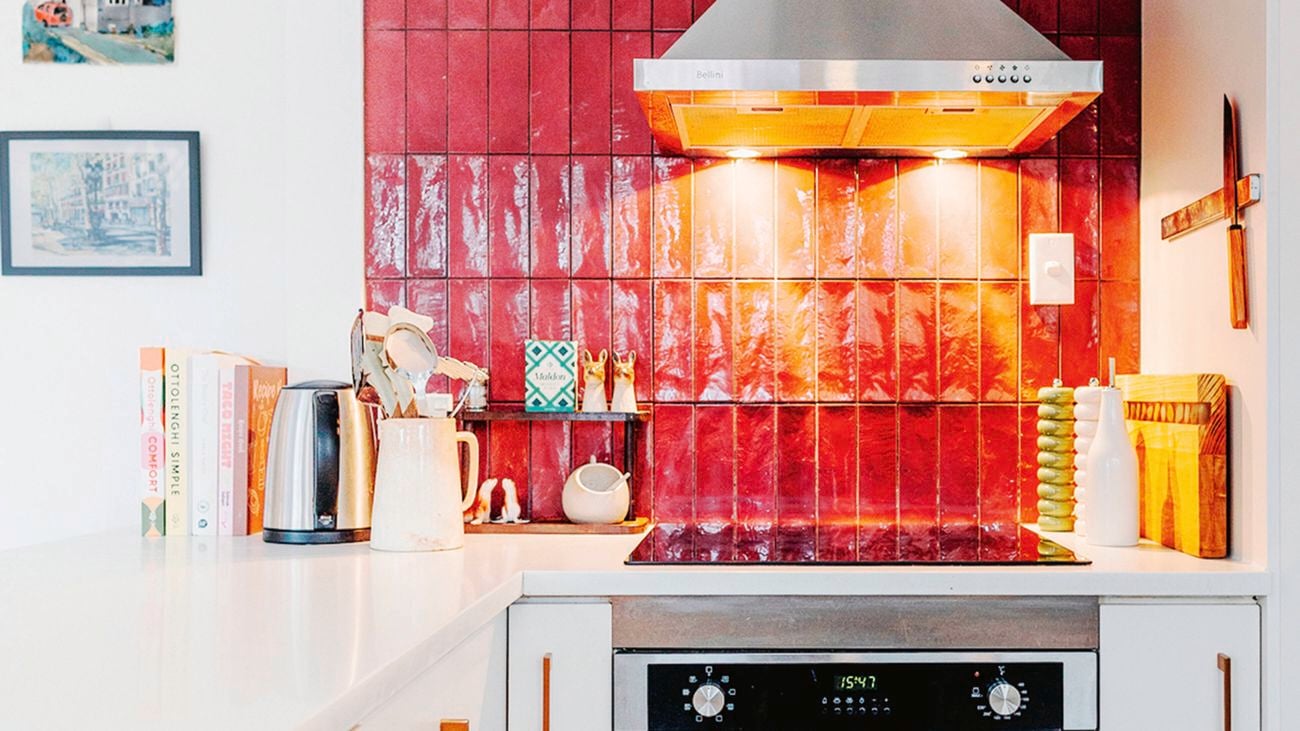
For their kitchen renovation, they restored the original tiles, re-gibbed and installed tongue-and-groove panels, and repainted the cabinetry. They are slowly doing up their home, mindful of retaining heritage features and keeping their home “livable” for the “very chill and patient” flatties. Read on for how they renovated their unique modern heritage-style kitchen.
Tip: Always wear the appropriate safety equipment (safety glasses, gloves, ear muffs and a mask, for example) and always follow the instructions for the product or equipment.

Key overview: How Aria and Brook did their D.I.Y. heritage kitchen renovation
- Preserve key unique features and add modern accents. Aria and Brook uncovered the original tiled flooring, which became the standout feature.
- Work with the quirks. Heritage homes can lack the simplicity of modern fittings and fixtures so be prepared to experiment with workarounds.
- Expect the unexpected. Unpredictable issues are common, so the couple spent time learning new skills and got used to starting from scratch several times on parts of the renovation.
- Be resourceful. Heritage homes are full of unique problems, so they had to be willing to experiment with solutions.
How to blend original and new features in a kitchen renovation
Doing up the kitchen (last renovated in the early 2000s) was the first major task for the couple. But while they knew they wanted to restore some of the kitchen’s heritage character, that direction took an unexpected twist. “We got a tip-off from a previous owner that the original tiled floors were under the laminate flooring, and when we lifted up the vinyl flashing, we realised it was these amazing chequered tiles,” says Aria. “Our style is quite colourful and a bit extra but, in an unusual move for us, we decided to choose more of a neutral backdrop for the rest of the kitchen, so the tiles could be the star.”
Find unique ways to solve old issues
The more the couple worked on the kitchen and butler’s pantry, the more quirks of the heritage home were revealed. Brook and Aria removed some of the 2000s-era wall tiles in both the kitchen and pantry to replace them with tongue-and-groove beadboard (also known as V groove or VJ). But lining everything up was not straightforward. “The tiles in the pantry were perfectly level and so was the skirting board, but when I got to the window, everything was off. The sides were different lengths and even the little block at the end of each windowsill was different,” says Brook.
“It felt really counterintuitive, but we had to cut these very precise, wonky-looking pieces of beadboard just to create something that had the illusion of being straight. Then I snapped the wood and had to do the whole thing again!”
Home makeover ideas for your storage
Storage and organisation projects, such as sorting your pantry or wardrobe, are not always immediately obvious to guests, but these small tweaks can have a big impact on your household. Try these tips to change your home storage:
- Consider how you and your family use a space. D.I.Y.er Kate van den Bergh, who is renovating a heritage villa, says accessibility was a key consideration in her busy home. “We customised shallow shelving in the kitchen for recipe books, and separate low shelving for kids’ bowls, cereals, snacks and pet food, so everything is within easy reach and the kids can help themselves,” she says.
- Similar considerations should be made for wardrobes. “If you need to see your clothes to decide what to wear, drawers might not be the best option,” advises Kate. “Telescopic pull-out rails and a mounted folding rail can make everything easier to view and access.”
- Use clear plastic boxes in cupboards. “We use clear, stackable boxes for the kids’ toys and rotate things in and out, which helps keep the clutter down and makes old toys feel new again,” says Kate. “Being able to see what’s inside also makes everything much easier to find.”
How to do a D.I.Y. kitchen renovation
- Learn to upskill. Before DJing, Brook worked as a motorbike mechanic, which instilled an innate fascination with understanding how things are put together. He also credits his ADHD (attention-deficit/hyperactivity disorder) as a D.I.Y. superpower.
- See it as a passion project. “One of the great things with ADHD is hyper fixations; you’ll get an idea in your head and that’s all you can think about,” he explains. So I hyperfocus, I do tons of research and get all the tools. I get up in the morning, work on the project, go to work, come home and then get straight back into it for another hour or two in the evening.”
- Find creative ways to stay on budget. The hyperfocus came in handy for the kitchen cabinet fronts, which the couple chose to repaint in order to keep costs down. The garage became a workspace for painting, a process which took several weeks. “I don’t think we realised how much work it would be sanding back and painting the cabinets, but this was when Brook’s perfectionism came into play,” says Aria. “We did so many coats, and we had to ban the cats from the garage to avoid their hair getting in it!”
- Patience yields the best results. Throughout the build, the couple found themselves dismantling and reassembling areas of the kitchen – intentionally and unintentionally! In order to lay new tiles on the floor of the butler’s pantry, Brook removed the door architraves and the assembled Kaboodle Kitchen cabinets within. Due to a slight miscalculation, the architraves were painted and reinstalled before the cabinets went back in, meaning Brook had to dismantle the cabinets and then reassemble them inside the pantry. “I’m not going to say it was my finest hour, but I had spent so long painting and installing the new architraves that the easiest solution was to dismantle and reinstall the cabinets,” he says.

What D.I.Y. renovation is worth it
With the kitchen done, Brook and Aria have found their D.I.Y. groove – although they now say they will always expect the unexpected with their heritage home. “Sometimes you just have to go with the flow on a heritage build,” explains Brook. “Things may not be level, and what may seem like a simple task can end up a can of worms. But that’s part of the character of the house, and it’s character building for us.”
Keep in mind...
- Paint colours may vary on application.
Inspired to update your own kitchen?
Check out our article six ideas for kitchen makeovers on a budget.
Photo credit: Emily Chalk.
Some advertised services and products are not available at some Bunnings stores, but products can be ordered. Some photographs feature products from suppliers other than Bunnings.


 Lowest Price Policy^
 Spend & Earn Rewards
 2 hour Click & Collect
 Easy in-store Returns
![Two vibrant purple and white passionfruit flowers with green leaves and tendrils. [[2609NZ] P...l Fruit_V1 | Word]](https://media.bunnings.com.au/api/public/content/155efdae0672480ca6efa0a2dee48200?v=f9102e18&t=w300dpr2)


 Get Inspired
 Ask Questions
 Share Projects